
Breakthrough in Brittle-Hard Material Machining: High-Efficiency Practice with the TKD-300F Laser Cutter
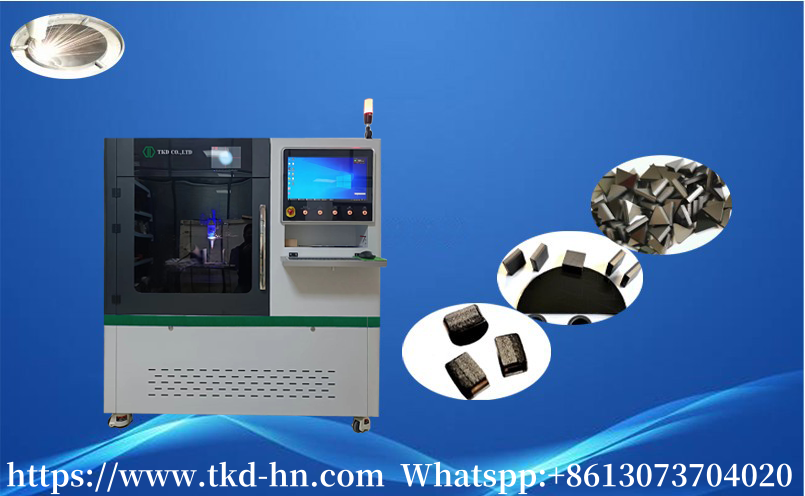
In the field of ultra-hard cutting-tool manufacturing, PCD (polycrystalline diamond) and CVD diamond have long been regarded as “tough nuts to crack.” Conventional wire-EDM, though mature, struggles when dealing with non-conductive materials or when extreme edge quality is demanded. TKD CO., LTD’s newly launched TKD-300F laser cutter is a precision powerhouse purpose-built for the complex characteristics of PCD, ceramics, sapphire, and similar materials.
Efficiency Revolution: From Microns to Throughput
For any machining workshop, productivity equals lifeline. The TKD-300F employs advanced short-pulse laser technology (with optional picosecond source) that effectively eliminates the excessive heat-affected zone (HAZ) associated with nanosecond sources.
In real production, cutting speed scales directly with material thickness. The table below summarizes TKD-300F’s measured performance on standard PCD composite wafers (total thickness 1.6 mm):
Material | Thickness (mm) | Cutting Speed (mm/min) | Edge Chipping | Surface Roughness (Ra) |
Standard PCD | 1.6 | 200 – 230 | < 0.005 mm | 0.4 – 0.8 µm |
CVD Diamond | 1.0 | 50 – 80 | < 0.003 mm | 0.3 – 0.5 µm |
Alumina Ceramic | 2.0 | 80 – 120 | No visible | 0.5 – 1.0 µm |
By optimizing control algorithms, TKD-300F’s breakpoint-resume function is extraordinarily accurate. Even after an abrupt shutdown, the system can relocate the exact cutting position via high-precision CCD vision with micron-level error, eliminating costly scrap of premium composite wafers.
Quality Deep-Dive: Not Just Cutting, But “Forming”
The core challenge in laser-cutting PCD is diamond-layer graphitization. Excessive laser heat input produces a graphite layer that is hard to remove and severely impairs subsequent brazing strength and wettability.
TKD-300F delivers a “cold machining” effect through extremely high peak power and ultra-short pulse width. The cut edge is clean and perpendicular; the ablation rates of the carbide substrate and diamond layer remain perfectly synchronized, eliminating the common “stepped” profile. For thick composite wafers, perpendicularity error is kept within 0.01 mm/mm, slashing subsequent grinding allowance. In certain woodworking-tool applications, the cut edge is so precise that “cut instead of grind” becomes feasible.
Production Continuity & Economics
Taking a standard woodworking edge-band blade (12 × 12 mm) as an example, TKD-300F can stably output 35–50 pieces per hour. Thanks to the laser’s exceptionally long maintenance-free period (typically > 20,000 hours) and dedicated fixtures developed for stacked multi-piece cutting, auxiliary loading time is reduced by more than 30 %.
Summary
The TKD-300F is more than a cutting machine; it is a complete solution for ultra-hard material processing. It resolves a series of process bottlenecks—from edge chipping and thermal distortion to brazing wettability—empowering tool manufacturers to leap from “machinable” to “precision-machined” amid fierce market competition.
About TKD CO., LTD
TKD focuses on laser-processing technology for brittle-hard materials. The TKD-300F series is now widely adopted in global precision cutting-tool, semiconductor ceramic, and aerospace component manufacturing sectors.
========================================================FAQ===============================================================
Q1: What are the primary advantages of the TKD-300F compared to traditional Wire-EDM?
A: The most significant breakthroughs are in processing versatility and edge integrity. Traditional EDM is limited to conductive materials, suffers from slow processing speeds, and often leaves a heat-damaged layer on the edge. The TKD-300F utilizes physical laser ablation, allowing it to easily handle not only PCD and PKD composites but also non-conductive, brittle-hard materials like CVD diamond, ceramics, and sapphire. Furthermore, as a non-contact process, it eliminates electrode wear and macro-cutting forces, keeping edge chipping under 0.005 mm for superior precision.
Q2: When cutting PCD, how does the system address the common issues of "graphitization" and "brazing difficulty"?
A: This is a core strength of the TKD-300F. Conventional lasers often generate excessive heat, causing the diamond layer to convert into graphite (carbonization), which severely compromises brazing strength. We employ an ultra-short pulse laser source that achieves a "cold machining" effect via high peak power, resulting in a negligible Heat-Affected Zone (HAZ). This ensures an ultra-thin oxide layer and maintains excellent wetting properties, allowing the cut inserts to undergo high-strength brazing without the need for intensive post-process grinding.
Q3: How does the TKD-300F perform in terms of real-world production efficiency?
A: Efficiency is about total throughput, not just linear cutting speed. For a standard 1.6 mm PCD composite, our measured linear speed reaches 200–230 mm/min. For common 12×12 mm woodworking edge-band inserts, the stable output is 35–50 pieces per hour. The system delivers exceptionally high production density while maintaining remarkably low energy consumption.
Q4: Will an unexpected power outage or sudden downtime result in the scrapping of expensive composite blanks?
A: Not at all. The TKD-300F comes standard with an intelligent breakpoint-resume function. The machine automatically relocates the exact coordinates where it left off, with a repositioning error within the micron range. This means that even with premium imported PCD or thick CVD materials, you can resume cutting seamlessly after an interruption, effectively reducing the risk of material scrap to zero.
Q5: What can be expected regarding equipment stability and maintenance costs?
A: The TKD-300F is engineered for high-volume industrial production. The core laser source boasts a maintenance-free period of over 20,000 hours with extremely slow power degradation. The frame is optimized with thermal compensation to ensure that perpendicularity error remains within 0.01 mm/mm during continuous, long-term operation. Thanks to the minimal consumption of wear parts, the per-unit processing cost of the TKD-300F is significantly lower than that of conventional methods.



 Whatsapp/wechat